
This Time for Sure
Beer

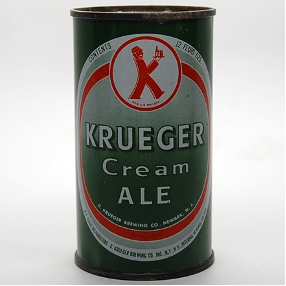
Author’s note: Beer-in-a-can was a marvel of modern engineering, first test-marketed in New Jersey (1933)—Krueger Finest Beer and Cream Ale.
In my youth, beer cans were fabricated from steel and required a “church key” to open them, no easy chore for an eight-year-old boy. The opener was comprised of a pointed hook affair with a tab that fit under the rim of the can. By prying upward, you could rotate the pointy end down through the top of the can and free the effervescent magic within. A second, smaller hole was made similarly on the opposite side of the can to allow air to displace the beer as it was poured. The trick for an eight-year-old was not to spill the can while attempting this maneuver. With some practice, I mastered this feat. Whenever my father asked me to get him a “cold one,” my reward was to slurp off the froth that accumulated on the top of the can after opening.
As best I know it, my father was not very close to his older brother, Ed. My dad was a “surprise” child born eighteen years after his older brother. Occasionally, we visited Ed and his wife, Charlotte. Ed drove a Studebaker, a bit exotic from my experience, and he was a proud member of the Knights of Columbus, which was a drinking fraternity as best I could tell. Ed loved his beer. I’m not sure how it happened, but whenever we visited, Charlotte played The Wizard of Oz on the television for my entertainment, while the grown-ups drank beer in the kitchen and discussed the events of the day. It was the favorite movie of my youth.
The Rose family were my parents’ best friends for many years. They lived in Jersey City, NJ, the city where my parents grew up. We visited the Roses occasionally. A bar was located on the street corner, around from where they lived, typical for that time. From time to time, I would accompany my father or Aunt Mabel to buy a quart of draft beer to-go. Draft beer was served in cardboard containers. My father would order a glass of beer while awaiting the foam on his to-go container to settle, and I would get a fizzy, orange soda. At that age, I could barely see over the edge of the bar, so my nose was barely above the rim of the glass. I still remember the effervescence of those bubbles hitting my nose—and the intoxicating aroma of that soda—glorious, orange soda!
The Roses included my “Uncle” Mike, “Aunt” Mabel and their two girls, Lorraine and Elizabeth “Betty” Ann, though all titles were honorary. I remember never seeing Uncle Mike out of his chair or without a can of Schlitz in his hand. Whenever he disapproved of the behavior of one of his daughters, he would preface his reprimands with, “If I told you once, I’ve told you fourteen times...” Apart from this idiosyncratic phrase, he was quite unremarkable.
At some point, our families’ friendship waned. We later learned of Uncle Mike’s premature death and Aunt Mabel’s remarriage... to the bartender on the corner, who had served me that orange soda many years before.
Aunty Ann Miller was Aunt Mabel’s sister. She lived alone in Union City, close to Jersey City, and never married as far as I knew. In my limited experience, this made her unique and a bit mysterious. She had a more refined air than the other of my parents’ friends, didn’t drink beer and had one of those high-fidelity record players that more resembled a piece of furniture than something that produced sound. Lifting a door revealed a turntable hidden in its center. On either side were a pair of built-in speakers. I recall listening to Prokofiev’s Peter and the Wolf for the first time on that hi-fi.
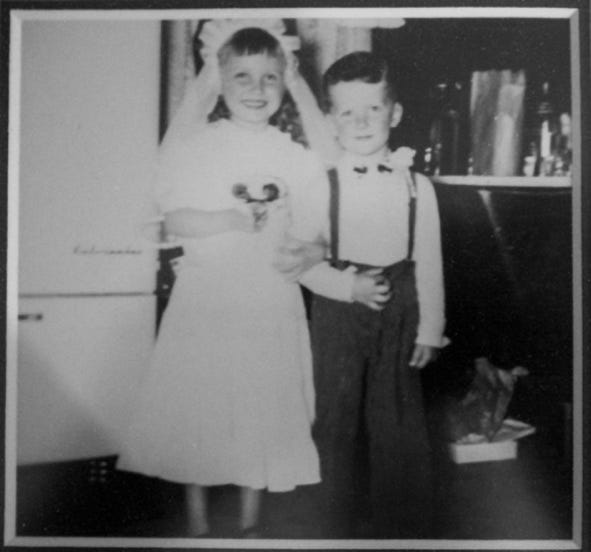
Betty Ann Rose became my first “bride” at the fiftieth wedding anniversary of my grandparents, Henry and Bertha. We were six or seven years old. I have no personal recollection of this event except for the grainy, 8mm movie my father had recorded of the two of us dancing while my grandparents, beers in hand, looked on. Betty Ann was half a head taller than me. She wore a white dress (probably worn at her First Communion), and I wore a white shirt, dark trousers with suspenders. We were quite the couple!
I was infatuated with Betty Ann for many years thereafter. She was a city girl, and I was a country bumpkin. I listened to Dean Martin records, while she swooned over the Beatles... whoever they were. I envied her “sophistication” and hoped that someday some of that sophistication would rub off on me, though it never did.
My grandfather must have died shortly after my only dance with Betty Anne Rose, because I have no memories of him afterward. But we visited Grandmother Bertha many times. She spent most of her time sequestered in a rocking chair placed six feet in front of a television set that apparently had no off button.
The most intriguing thing about her drab, one-bedroom, walk-up apartment was her bathroom. The flushing mechanism centered around a large porcelain tank perched high above the toilet, where a chain dangled down with an oaken handle attached. When I grabbed the handle and pulled downward, it unleashed a torrent of water that threatened to flood the apartment with each pull. Whoosh! A tsunami with each flush. I was in awe.
As far as I knew, Grandma Bertha didn’t know how to cook, as she never practiced that art in my presence. The only saving grace for these visits to see Bertha, apart from her toilet, was the sight of the magnificent Anheuser-Busch Brewery eagle ablaze in neon at night as we passed through Newark on our way home.
Many years later, my father and I toured that Anheuser-Busch Brewery. At the completion of our tour, they served my father a glass of Michelob, and I ordered a glass of orange soda... of course.
Rose
A rose by any other name
is still a rose.
Hers was Betty Anne
Rose, that is.
I was too young to marry,
I thought.
Betty Anne thought otherwise.